








- Main
- FAQ
- Other questions
- How does a search engine find new website pages?
How does a search engine find new website pages?
- General questions about indexing
- How 2index.ninja works
- Indexing of website pages
- Backlink indexing
- Checking Google indexing
- Tariffs, tokens, and payment
- API and bulk work
- Guarantees, deadlines and results
- Safety and restrictions
- Technical questions
-
Other questions
- How to use competitor tracking in your backlink acquisition strategy?
- How important is content when attracting backlinks?
- How to ensure good page loading speed for better indexing and optimization?
- What page optimization recommendations will help improve their indexing?
- How to check which pages have been indexed by a search engine?
- How does internal linking help optimize for Yandex indexing?
- How does fast indexing affect search results positions?
- How can you monitor the quality of external links to your site?
- What methods can be used to find potential backlink sources?
- What tools are available for backlink monitoring?
- How to evaluate the quality of backlinks?
- How does optimizing for fast website loading speed affect indexing in Yandex?
- How does using a robots.txt file affect Google indexing?
- What specific optimization recommendations can be applied for better indexing in Yandex?
- How to evaluate the domain authority and page authority of another web resource?
- How do you check which pages of your mobile site are indexed by Google?
- How to choose the right keywords for a specific page?
- How do you take page loading speed into account when optimizing for fast indexing?
- How does content length affect page indexing and ranking?
- What are the benefits of website page indexing services?
- What is a canonical URL and how is it used in SEO?
- What are the basic steps to improve Google indexing?
- How to make sure your website is mobile-friendly for Google?
- How to create and submit a sitemap to Google?
- How to speed up the indexing process of new website pages?
- How do social signals affect SEO?
- How to choose the right keywords for your website?
- What mistakes should you avoid when attracting backlinks?
- How can content marketing be used in a backlink acquisition strategy?
- What metrics should you track when evaluating the effectiveness of your backlink acquisition strategy?
- What is the role of anchor texts in backlink acquisition strategy?
- What types of backlinks exist?
- What are the benefits of attracting backlinks?
- What roles do social media play in SEO?
- What are long-tail keywords and how are they used in SEO?
- What content is considered quality from an SEO perspective?
- How to measure SEO effectiveness and what metrics should you track?
- What is organic search?
- What is a Sitemap and How Does it Help SEO?
- What is crawling and how does it relate to indexing?
- What SEO analysis tools can be used?
- What are backlinks (external links) and how do they affect SEO?
- What factors influence website loading speed and why is it important for SEO?
- What are keywords in SEO?
- What are meta tags and how do they affect SEO?
- What is SEO (Search Engine Optimization)?
- What is Yandex.Webmaster?
- What is Google Search Console?
- What is an active link?
- How does a search engine find new website pages?
- How to check the result
- How long does indexing take?
- How does this work
- How much will it cost?
- Will all pages and links be indexed?
A search engine finds new pages through a process called crawling, which is the process of crawling a website using robots (spiders).
Website crawling by robots
Search engines like Google and Microsoft Bing have automated bots (such as Googlebot). They constantly scan the internet, following links from known pages to new ones.
If a bot lands on a page of your website, it:
- loads HTML code;
- analyzes content;
- extracts links;
- adds new URLs to the crawl queue.
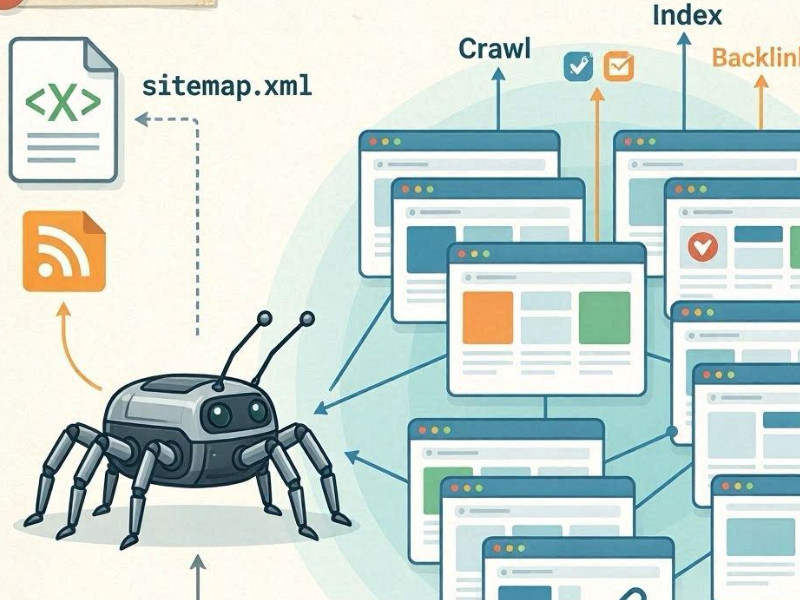
Internal links as the main discovery channel
The main way to discover new pages is through internal linking. If a new page:
- added to the menu,
- linked to an already indexed page,
- or is present in the catalog,
- then the bot finds it faster and adds it to the bypass.
Sitemap.xml
The second important source is the sitemap.xml file. This is a sitemap where you explicitly list all important URLs. Search engines use it as a "crawl plan," especially for new or deeply nested pages.
External signals
If a page has external links from other websites, blogs, or social media, it speeds up its discovery. For search engines, this is a signal that the content may be new and important.
Re-crawling
Search engines regularly return to already known sites. The frequency depends on:
- domain authority;
- content update frequency;
- user behavior.
The more active the site, the more often the bot checks for new pages.