








- Main
- FAQ
- Backlink indexing
- Why index backlinks?
Why index backlinks?
- General questions about indexing
- How 2index.ninja works
- Indexing of website pages
- Backlink indexing
- Checking Google indexing
- Tariffs, tokens, and payment
- API and bulk work
- Guarantees, deadlines and results
- Safety and restrictions
- Technical questions
-
Other questions
- How to use competitor tracking in your backlink acquisition strategy?
- How important is content when attracting backlinks?
- How to ensure good page loading speed for better indexing and optimization?
- What page optimization recommendations will help improve their indexing?
- How to check which pages have been indexed by a search engine?
- How does internal linking help optimize for Yandex indexing?
- How does fast indexing affect search results positions?
- How can you monitor the quality of external links to your site?
- What methods can be used to find potential backlink sources?
- What tools are available for backlink monitoring?
- How to evaluate the quality of backlinks?
- How does optimizing for fast website loading speed affect indexing in Yandex?
- How does using a robots.txt file affect Google indexing?
- What specific optimization recommendations can be applied for better indexing in Yandex?
- How to evaluate the domain authority and page authority of another web resource?
- How do you check which pages of your mobile site are indexed by Google?
- How to choose the right keywords for a specific page?
- How do you take page loading speed into account when optimizing for fast indexing?
- How does content length affect page indexing and ranking?
- What are the benefits of website page indexing services?
- What is a canonical URL and how is it used in SEO?
- What are the basic steps to improve Google indexing?
- How to make sure your website is mobile-friendly for Google?
- How to create and submit a sitemap to Google?
- How to speed up the indexing process of new website pages?
- How do social signals affect SEO?
- How to choose the right keywords for your website?
- What mistakes should you avoid when attracting backlinks?
- How can content marketing be used in a backlink acquisition strategy?
- What metrics should you track when evaluating the effectiveness of your backlink acquisition strategy?
- What is the role of anchor texts in backlink acquisition strategy?
- What types of backlinks exist?
- What are the benefits of attracting backlinks?
- What roles do social media play in SEO?
- What are long-tail keywords and how are they used in SEO?
- What content is considered quality from an SEO perspective?
- How to measure SEO effectiveness and what metrics should you track?
- What is organic search?
- What is a Sitemap and How Does it Help SEO?
- What is crawling and how does it relate to indexing?
- What SEO analysis tools can be used?
- What are backlinks (external links) and how do they affect SEO?
- What factors influence website loading speed and why is it important for SEO?
- What are keywords in SEO?
- What are meta tags and how do they affect SEO?
- What is SEO (Search Engine Optimization)?
- What is Yandex.Webmaster?
- What is Google Search Console?
- What is an active link?
- How does a search engine find new website pages?
- How to check the result
- How long does indexing take?
- How does this work
- How much will it cost?
- Will all pages and links be indexed?
Backlink indexing is necessary so that search engines can actually "see" the donor page and register the link it contains. Until a page is discovered and indexed, a link from it may technically exist, but it won't be included in the calculation of link signals for ranking in systems like Google and Yandex.
From an SEO perspective, this means a simple thing: an unindexed source page conveys little or no value. The search engine robot has either not yet reached it, or it has crawled it but not included it in the index. In both cases, the link is effectively "inactive" for ranking algorithms.
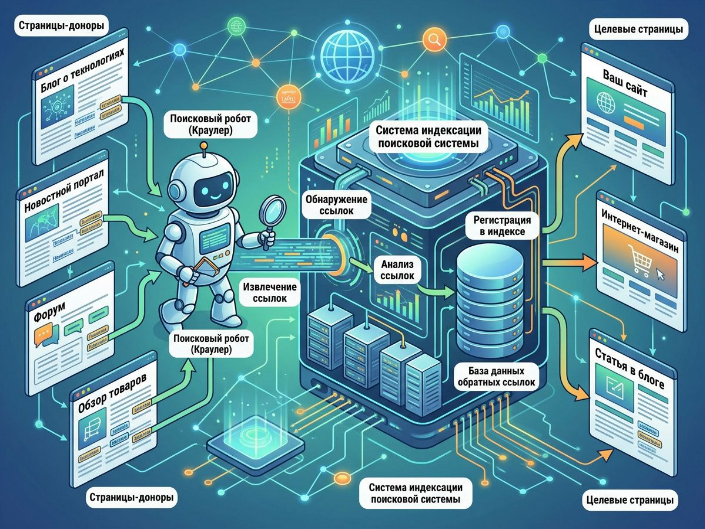
This is why backlink indexing is considered a separate stage of link building. First, a link is placed, then it's important to ensure its discovery by search engines, and only then can one expect a full SEO effect. Without this step, part of the link profile may remain unaccounted for.
This is especially critical for links placed on pages with low internal visibility: forums, comments, profiles, crowdfunding platforms, web 2.0 sites, small blogs, or pages without strong internal linking. Such URLs may be indexed slowly or even completely missed by crawlers.
Accelerating backlink indexing helps reduce the gap between a link's placement and its actual ranking. The faster a search engine discovers a source page, the sooner the link begins to contribute to the site's authority and influence its rankings.
It's important to understand that indexing alone doesn't guarantee link strength. Search engines evaluate not only the existence of a link but also the quality of the source: its topic, trustworthiness, page structure, the link's context, and the site's overall profile. Therefore, indexing doesn't strengthen a link, but rather includes it in the evaluation process.
The bottom line is simple: if a link isn't indexed, it may not work at all; if it is, it has a chance to influence SEO, but its actual effectiveness still depends on the quality of the source.